Early Years
Text
Central to our Early Years provision is our school mission of Growing hearts and minds together. We aim to nurture curious, confident and engaged learners by providing strong foundations for lifelong learning. Through high‑quality interactions, rich continuous provision and child‑led play, children become resilient, independent learners with strong communication and language, social and emotional and physical development skills.
Quality texts and a strong emphasis on vocabulary underpin our curriculum, enabling children to communicate effectively and develop a love of language and stories. We value the importance of positive relationships and nurturing a strong sense of belonging, supporting children’s emotional well‑being so that every child feels safe, valued and supported. Teaching is responsive to children’s starting points, with ongoing assessment used to identify progress and provide timely early intervention where needed. We work closely with families and colleagues across the school to support smooth transitions between year groups and key stages, ensuring continuity, consistency and ambition for all children.
Early Years Experience
Every day, we provide opportunities for children to come together to share their experiences and have fun. Our children are happy, proud and feel secure knowing that we celebrate their successes and value their achievements. The curriculum is centred around children’s interests with a balance of child-initiated and adult-led learning.
Our learning environment facilitates child-initiated play and provides children with carefully planned opportunities which allow children to explore, create and learn through exciting, stimulating, interactive and accessible resources.
Early Years Foundation Stage
The EYFS is a very important stage in a child’s life as it helps prepare for school ‘readiness’ as well as preparing them for their future learning and successes. Children’s early years experience should be happy, active, exciting, fun and secure; and support their development, care and learning needs. Every child deserves the best possible start in life and the support that enables them to fulfil their individual potential. Children develop quickly in the early years and a child’s experiences before the age of five will have a major impact on their future life chances.
The EYFS framework explains how and what children will be learning to support their healthy development and provide the foundation children need to make the most of their abilities and talents as they grow up. The EYFS specifies requirements for learning and development and for safeguarding children and promoting their welfare.
Children learn skills, acquire new knowledge and demonstrate their understanding through 7 areas of learning and development.
Children should mostly develop the 3 prime areas first. These are:
-
Communication and language;
-
Physical development; and
-
Personal, social and emotional development.
These prime areas are those most essential for a child’s healthy development and future learning.
As children grow, the prime areas will help them to develop skills in 4 specific areas. These are:
-
Literacy;
-
Mathematics;
-
Understanding the world; and
-
Expressive arts and design.
All 7 areas of learning are used to plan children’s learning and activities. The staff teaching and supporting your child ensure that the activities are suited to your child’s unique needs. This is a little bit like the curriculum in the rest of the school but it's suitable for very young children, and it's designed to be really flexible so that staff can follow your child's unique needs and interests.
Children in the EYFS learn by playing and exploring, being active, and through creative and critical thinking which takes place both indoors and outside. It is very important that they develop social skills, such as turn-taking, sharing and independence, which help them greatly in the next stages of their learning. The guiding principles that shape our practice in the Early Years are that children are born ready, able and eager to learn. They actively reach out to interact with other people, and in the world around them. Development is not an automatic process, however. It depends on each unique child having opportunities to interact in positive relationships and enabling environments.
This does not mean that all your child's learning is divided up into specific areas. One experience may provide a child with opportunities to develop a number of skills and concepts across several areas of learning.
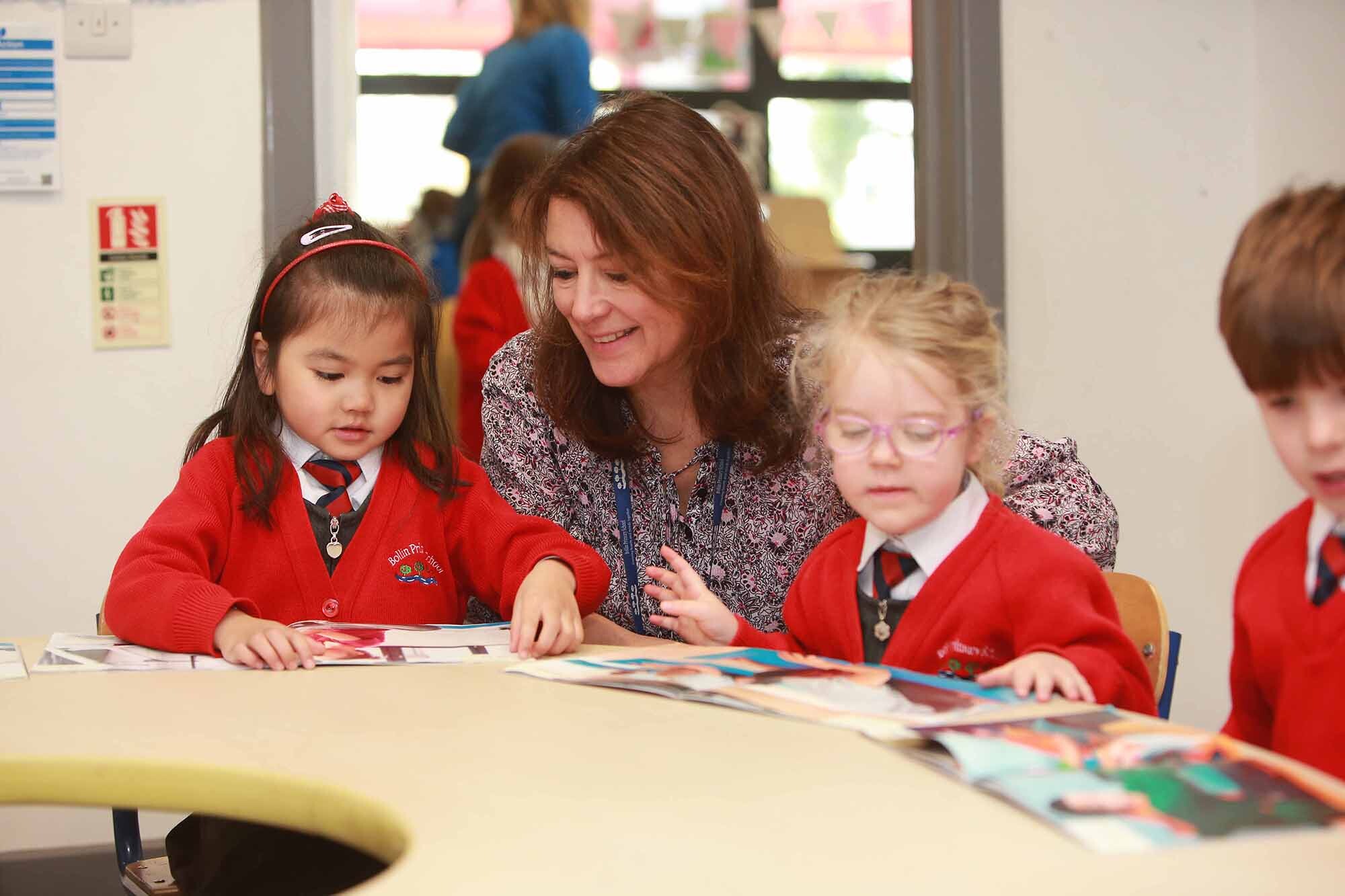
If you visited Nursery or a Reception class, you would see a range of activities taking place such as role-play, practical games, painting, cutting and sticking and reading in the book corner. You would equally see learning in both the indoor and outdoor environment. Children work and play independently, with a strong emphasis on choice and being able to sustain concentration on projects, as well as joining a variety of child and adult-led activities.
Early Learning Goals
The EYFS curriculum consists of 17 aspects of learning, at Bollin we provide our pupils with the opportunities the meet the Early Learning Goals in all of these aspects.
Throughout the year, we have opportunities for you to come to stay and play sessions, as well as meeting with the teaching staff to discuss your child’s individual wellbeing and progress.
The Role of the Early Years Teaching Team
Professional Development and Expertise
Our Early Years team is committed to continual professional development to ensure our practice reflects the latest research into child development and language acquisition. As highlighted in Birth to 5 Matters, "the quality of interactions between adults and children directly affects the quality of children's learning." We understand that children learn language through warm, responsive relationships and meaningful conversations with skilled adults.
By continually developing our understanding of early language development, we ensure that every interaction supports children's communication, thinking and learning.
Our Early Years Leads
Our Early Years provision is led by Mr Shaun Lane, our EYFS Lead, who is passionate about creating a nurturing and engaging environment where every child can flourish.
Supporting this work is Miss Sophie Smith, our WellComm Co-ordinator. Miss Smith oversees the implementation of the WellComm screening and intervention programme, helping us to identify and support children with speech, language and communication needs at the earliest opportunity. Through timely support and targeted interventions, we ensure all children have the strongest possible foundations for learning.
Our Approach
-
Quality Interactions and the ShREC Approach
At Bollin Primary School, we place high-quality interactions at the heart of our Early Years practice. Research shows that the conversations children have with adults play a vital role in their language development, thinking skills, and overall learning.
To support this, our staff use the ShREC approach:
Share Attention
We tune into children's interests and focus on experiences together to create meaningful moments for communication.Respond
We listen carefully and respond sensitively, showing children that their thoughts, ideas, and attempts to communicate are valued.Expand
We build upon children's language by modelling new vocabulary and extending sentences, helping them develop increasingly sophisticated communication skills.Conversation
We encourage sustained back-and-forth conversations that deepen thinking, develop understanding, and enrich vocabulary.Through these high-quality interactions, we help children become confident communicators who are curious, engaged and ready to learn.
-
Communication and Language
WellComm is a speech and language screening tool used in many primary schools and early years settings. It helps our teaching staff to identify children who may need extra support with their speech, language, and communication skills.
WellComm supports all seven areas of learning because communication is at the heart of child development. By identifying and addressing speech, language and communication needs early, WellComm helps children access the curriculum, build relationships, develop confidence, and achieve positive outcomes across all areas of the EYFS.
What is WellComm?
-
A simple speech and language screening tool used in early years
-
Helps us understand how children's communication skills are developing
-
Used with all Nursery and Reception children
What does it involve?
-
10-15 minutes of play-based activities and observation with a familiar adult
-
Looking at understanding, talking, listening and attention
-
Takes place in school during the first few weeks
Why do we use it?
-
To identify children who may benefit from extra support early
-
To help us plan an environment and activities that support communication and language development
-
To ensure every child can access learning and feel confident
What happens next?
-
Most children will continue with classroom activities as normal
-
Some children may receive small group or targeted support in school
-
We will always keep you informed and offer ideas to support at home where appropriate
-
-
EExREC
Our approach to communication and language development is also informed by the principles of EExREC, which recognises the vital role that rich interactions, responsive adults and purposeful experiences play in supporting children's communication skills. This reflects our commitment to creating language-rich environments where children are encouraged to explore, question, communicate and develop confidence in expressing their ideas.
The guidance emphasises that effective communication development is not delivered through isolated activities but is woven throughout children's daily experiences. Through our use of WellComm, high-quality adult interactions, carefully planned learning opportunities and strong partnerships with families, we ensure that communication and language remain at the heart of our Early Years provision.
Phonics and Handwriting
-
Learning to Read at Bollin Primary School
At Bollin Primary School, we are committed to ensuring that every child becomes a confident, fluent and enthusiastic reader. To support this, we use Little Wandle Letters and Sounds Revised, a Department for Education validated Systematic Synthetic Phonics (SSP) programme that provides a clear, carefully sequenced approach to teaching reading and spelling.
Why do we use Little Wandle?
Little Wandle is based on the latest research into how children learn to read. It enables children to develop secure knowledge of the relationship between sounds (phonemes) and the letters or groups of letters (graphemes) that represent them, building confidence and fluency over time. The programme includes regular review and assessment, ensuring that all children make strong progress and receive additional support where needed.
-
How is Phonics Taught?
Phonics is taught daily in Reception and Key Stage One. Children learn to:
-
Recognise and recall sounds and graphemes.
-
Blend sounds to read words.
-
Segment words for spelling.
-
Apply their phonics knowledge when reading and writing.
Learning is carefully sequenced and regularly revisited to help children move knowledge into their long-term memory.
-
-
Reading Practice Sessions
Children take part in three adult-led reading practice sessions each week, with each session focusing on a different aspect of reading:
-
Decoding – reading words accurately using phonics knowledge.
-
Prosody – developing fluency, expression and pace.
-
Comprehension – discussing and understanding what has been read.
Re-reading the same text across the week helps children build confidence, fluency and understanding.
-
-
Reading Books
Children take home books that are carefully matched to the sounds they have already secured in phonics lessons. These fully decodable books allow children to practise and apply their learning successfully, helping them develop confidence and independence as readers. All books are closely aligned to the Little Wandle progression.
-
Little Wandle Handwriting
Developing Fluent, Confident Writers
At Bollin Primary School, we use Little Wandle Handwriting, a structured programme that runs alongside our Little Wandle Letters and Sounds Revised phonics programme. The programme is designed to develop accurate letter formation, handwriting fluency and confidence from the very start of Reception.
Why do we use Little Wandle Handwriting?
We believe that fluent handwriting enables children to focus on communicating their ideas rather than thinking about how to form letters. Little Wandle Handwriting provides a clear progression, direct teaching and regular opportunities for practice, helping children develop strong foundations for future writing.
-
How is Handwriting Taught?
Handwriting begins in Reception and is taught through four dedicated sessions each week. Lessons are short, focused and include:
-
Direct teacher modelling.
-
Explicit teaching of letter formation.
-
Regular practice and repetition.
-
Immediate feedback and support.
Children learn letters through carefully planned letter families, helping them recognise common movement patterns and develop handwriting efficiently.
-
-
Supporting Handwriting Across the Curriculum
Handwriting is not limited to discrete lessons. Children also practise letter formation during daily phonics lessons using lined whiteboards, allowing them to apply their developing knowledge of sounds and letters in meaningful contexts.
A strong emphasis is placed on the Little Wandle "Ready to Write" approach, which teaches children the four key elements of successful handwriting:
-
Posture
-
Pencil Grip
-
Paper Position
-
Pressure
These routines are taught explicitly and consistently so they become automatic habits.
-
Text
Our Children
Through all of the approaches that we use, our children are happy. They are excited and motivated to learn through rich and challenging learning experiences; opportunities to explore and take risks, and first-hand experiences.
We have high ambitions for all our children and recognise that children have different starting points to their learning. We plan according to children’s stage of development so all can thrive and develop. We aim for children to be well-rounded individuals who are independent, resilient, and confident in themselves and with others.
We are delighted to share that 85% of our children reached a Good Level of Development (GLD) in July 2026. This is significantly above the national average of 72%.
Parent Partnership
We encourage a partnership with parents so you are actively involved in your children's learning. Our partnership with you means that you have the opportunity to work closely with our Early Years staff to support children’s transition into the setting. We would like you to feel secure in the knowledge that your child is well cared for and happy at school.
Our parents are welcome to be actively involved in their children’s learning in school and are able to share learning experiences through ‘stay and play’ sessions, staggered starts, volunteering and parent workshops. We recognise that parents are the first educators in children’s lives and value contributions to judgements about children’s development. We use this information to support our assessments and share information about what children need to do next to develop and thrive.